
The Universal Church of the Kingdom of God (Igreja Universal do Reino de Deus) is a Pentecostal Christian denomination with its headquarters at the Temple of Solomon (São Paulo). It was founded on July 9, 1977 in Rio de Janeiro by Edir Macedo - wikipedia 
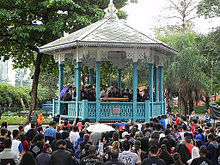
Gazebo of Jardim do Méier Square, place where UCKG began -
- wikimedia.org
July 9, 1977: founded
In 1999 it had 8 million members in Brazil, and had established temples in the United Kingdom and, since 1992, set up temples in Africa and in India, with a 1999 total of more than 12 million members worldwide. By 2013 UCKG had congregations in the New York City borough of Brooklyn and other US locations.

Cathedral of Faith in Rio de Janeiro, Brazil.
- wikimedia
The Church has frequently been accused of illegal activities and corruption, including money laundering, charlatanism, and witchcraft, and intolerance towards other religions. It has been subject to bans in several African countries.
See revolvy.com
A London UCKG pastor in 2000 arranged a service to cast out the devil when his help was sought for an ill and badly injured child whose guardians thought her possessed; she died and her guardians were convicted of murder. There have been accusations that the Church extracts money from poor members for the benefit of its leaders.
# History from 1989
UCKG expanded to Portugal in 1989, the first European location for the UCKG. Their proselytism was aggressive, and they were accused of charlatanism and commercial interests that put into question their claims to be a religious organisation.
During the 1990s they were very visible and energetic, attacked the Catholic Church, and amassed contributions sufficient to build a "gigantic" temple in Porto.
In 1995, a scandal ensued after the attempted purchase of the well-known theatre Coliseu do Porto to transform it into a temple. The Church then began expanding into Eastern Europe.
In 1989 Macedo and the Church purchased Rede Record, which by 2013 was Brazil's second-largest television network. In 2009 the Workers' Party (Workers' Party (Brazil)) (PT) government in Brazil bought advertising from Rede Record, which it had formerly limited to Catholic publications, in new venues, and paid for public service messages in UCKG media outlets.
The church follows prosperity theology, asserting that faith and commitment to a church are rewarded with wealth, and in the late 1990s started trying to change its image of being associated with only the poorest people. In 1998 Macedo appointed his nephew Marcelo Crivella as Bishop. Crivella said, "We want to win the middle class."
In 1992, Crivella began a mission in Africa, resulting in the creation of multiple UCKG temples. Crivella returned to Brazil in 1998, and was given a four-bedroom condominium in an exclusive development, where Macedo also lives. He is married to Sylvia Jane, with three children who attend a Methodist school in Río de Janeiro - veja.abril.com.br
# Film
UCKG has a number of connections with TV (RecordTV), film and cinema - see UCKG and film promotion
# UCKG Music
Some observers of the time thought that Crivella was being promoted as a competitor to the popular Catholic priest-singer, Marcelo Rossi, who had sold over 4 million albums.
In 1999 Crivella was reported to have signed a contract with Sony Music to make three albums, one in Spanish. The first CD, ''The Messenger of Solidarity'', sold 1.3 million copies that year.
Crivella was the only pastor whom Macedo authorized to hold large events in stadiums. He has been effective at attracting crowds: the first time appearing at the Nilson Nelson gymnasium in Brasilia, with a capacity for 25,000 people; he filled the Estádio Fonte Nova in Salvador, and the Mineiro in Belo Horizonte.
In October 1999, Crivella packed the Maracanã football stadium (Estádio do Maracanã) in Río de Janeiro. By the end of that year, Crivella planned to have sung "in the largest football stadiums in the country" according to weekly news magazine ''Veja (Veja (magazine))''.
# See also * History * Activities * Finances * Influence * Doctrines * Tithing and offerings * Relations with other religions * Controversies - RecordTV - Temple of Solomon (São Paulo) - UCKG and film promotion